
Search results for
(Showing 45-60 out of 337 results)
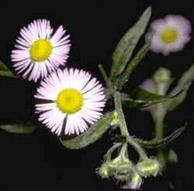
Fleabane is part of the Aster family and blooms from April through June. Fleabane looks like a daisy, with about a 100 ray-like petals that can be white or pinkish. The centers are yellow.
Read More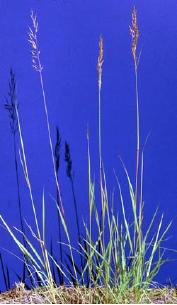
Indian Grass is a perennial bunchgrass native to the United States. It is known as a warm season grass and will start growing in May, and go to seed in July and August. It has yellow spikelets (seed heads) that have white hairs.
Read More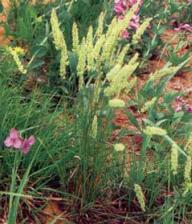
June Grass has pale green-silvery colored flowers. Its lower stems are covered with small hair about .5 inches along the stem. The stem is hollow at the bottom of the plant.
Read More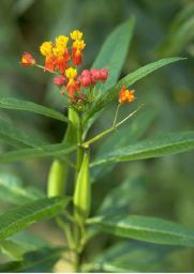
This herb produces red and yellow blossoms in the spring which are less than an inch across. The 5 outside petals, or corolla, are red and curve down. The 5 inside petals are hooded and yellow or orange. They grow in a cluster at the top of woody stems
Read More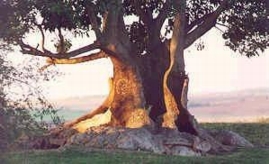
Did you know that there are bushes the size of large trees? In the Pampas grasslands in South America there is a "tree" called the Ombu. It is the only tree-like plant that lives on the Pampas because it does not need a lot of water to survive.
Read More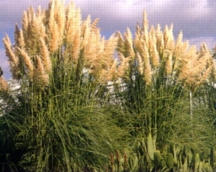
Pampas Grass is a sort of grass that dwells mostly in the Pampas of South America. It is a very pretty, large and unique kind of grass. The habitat of Pampas Grass is mostly moist areas in the South American grassland biome. The climate of this biome is pretty hot with grassy plains.
Read More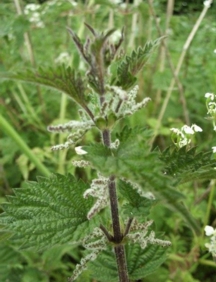
This plant is a very interesting plant. When you look at it, it looks like an ordinary, hairy weed with attractive little flowers. It can be a very dangerous plant, however, because when you touch it with your bare skin, you will get a terrible sting, which is very painful.
Read More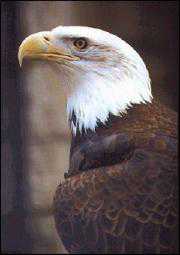
The Bald Eagle is the national bird of the United States of America. It is considered a sea eagle that has a white head. It is large and strong and weighs eight to twelve pounds
Read More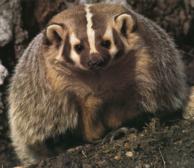
The badger is an animal with a stocky, powerful build, having four short, strong legs and large, sharp claws. It has a long, pointy nose, with a white streak from the tip of it all the way down its back.
Read More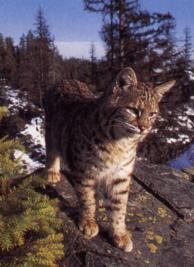
The large coniferous forest found in Canada is called the Taiga. There are many swamps, mountains and forests in the Taiga that are home to the Bobcat. Throughout much of the United States the bobcat lives in forests, but can also be found in desserts and chaparral.
Read More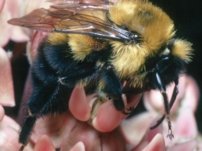
Imagine you are sitting on a nice grassy field having a picnic with a couple of friends. Suddenly you spot a black and yellow flash speeding right toward you. You panic immediately but sit as still as possible.
Read More
The Greater Rhea lives on the pampas, and open woodlands in the south-eastern part of South America. Although they live in the grasslands, they avoid open places and prefers areas with some tall vegetation.
Read More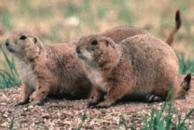
Imagine yourself on a huge open land with nothing to see but grass. when you look down you see a parade of little animals that almost look like squirrels. These are the prairie dogs. They are named after their dog-like yip.
Read More
There are many types of grasslands around the world. Some of the grasslands are tropical and some are dry grasslands. Grasslands in North America are known as Prairies, and in South America they are known as the Pampas.
Read More
The Steppe biome is a dry, cold, grassland that is found in all of the continents except Australia and Antarctica. It is mostly found in the USA, Mongolia, Siberia, Tibet and China.
Read More